
Guglielmo Poletti

Guglielmo Poletti: the designer who turned construction into art
Most designers begin with form. Designers draw the silhouette of a future object and then look for a way to realise the silhouette in a material. Guglielmo Poletti works in the opposite way. Poletti begins with construction, physical laws, tension, weight, balance and material resistance. Form appears only when engineering logic becomes precise.
This unusual approach attracted the attention of Flos, a company that has worked for decades with creators who change perceptions of lighting design. The first collaboration produced more than a new light: the project demonstrated that construction can become the main artistic image of an object.
Architecture instead of decoration
Guglielmo Poletti was born in Italy in 1987, earned a master’s degree at Design Academy Eindhoven and opened his own studio in Milan in 2016. Poletti’s work quickly attracted professional attention through an unusual research method. Instead of pursuing striking aesthetics, the designer studies how materials behave under load, turning gravity, tension and balance into practical design tools.
This approach made Poletti one of the most interesting representatives of a new generation of Italian design. Poletti focuses on an object’s internal principle rather than its visual effect. Poletti aims to show why an object looks the way it does.
How the collaboration with Flos began
The collaboration began in spring 2020. During the height of the pandemic, the designer received a letter from Flos curators Calvi Brambilla. The letter contained no technical brief, list of requirements or commercial restrictions. Flos offered the designer one opportunity: free research into personal ideas.
Such trust is rare today. The absence of a strict brief allowed Poletti to focus on personal research and propose a concept that fully matched the philosophy of Flos. The project took about a year and a half to progress from the first prototype to serial production. The team devoted most of that period to refining the construction details.
To-Tie: when the cable becomes construction
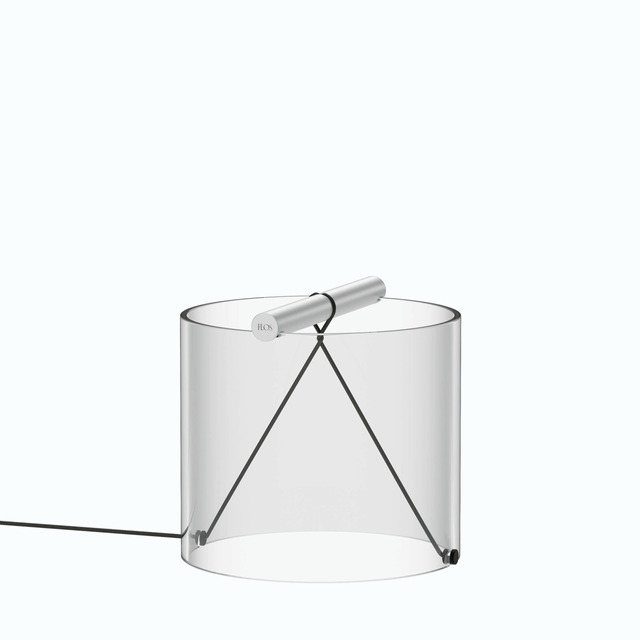
The result of the work was the To-Tie collection, presented in 2022.
At first glance, the light appears almost elemental: a glass cylinder, an aluminium bar and an electrical cable. The cable becomes the main structural element. The cable remains visible and creates a tension system that supports the entire composition.
The bar performs several functions at once. The bar contains the LED light source, serves as a carrying handle and connects all construction elements into a single whole.
Each detail performs several roles at once. This engineering versatility became the project’s main strength.
Simplicity with complexity behind it
Poletti’s work is often called minimalist, but that description is too superficial.
Minimalism is not an artistic device in Poletti’s work. Minimalism follows from strict construction logic. Any element that does not contribute to the object’s function disappears.
For that reason, the designer’s lights create an unusual impression. The lights appear to contain nothing unnecessary, yet removing any element would damage the entire system.
This structural honesty recalls leading examples of mid-century industrial design, interpreted through modern Flos technologies.
Light as a physical phenomenon
For Poletti, light never exists separately from material.
The glass cylinder of To-Tie does more than protect the light source. The cylinder forms part of the optical system by refracting light, creating depth and visually dissolving the boundary between construction and light flow.
A distinctive paradox appears: the viewer notices the construction and stops seeing the construction at the same time. The light seems enclosed within a transparent volume.
Poletti considers such visual contradictions the most interesting part of the work.
Why Flos chose Poletti
Flos has worked with several generations of leading designers during more than sixty years of existence. The arrival of a new name means more than a catalogue expansion. The arrival of a new name recognises a new authorial language.
Poletti interested the company through a research-based approach. Poletti does not copy existing lighting typologies. Poletti attempts to redefine their structural foundation.
This perspective fully corresponds with the philosophy of Flos. Flos treats innovation as the search for a more advanced engineering solution, not as a desire to surprise.
Antonovych Home expert opinion
Dmitry Korotchuk, director of the Antonovych Home showroom:
«Guglielmo Poletti’s work shows how engineering thought becomes aesthetics. The Flos lights created by Poletti make an impression of complete simplicity, yet every element reflects serious research. Objects of this kind remain relevant for decades because the objects rely on construction logic rather than fashion.»
Guglielmo Poletti belongs to a generation of designers who are returning an investigative character to the profession. Poletti does not aim to create striking objects for visual impact alone. Poletti studies the nature of an object: how the object is built, why the object remains stable and how material, gravity and light interact.
The collaboration with Flos allowed this research to move beyond an experimental studio and become an industrial product while preserving the intellectual depth of the author’s idea.
For that reason, To-Tie is perceived as more than a table lamp. To-Tie demonstrates that contemporary design can combine engineering, art and a philosophy of construction.
Guglielmo Poletti pieces
Looking for the right Italian furniture?
Antonovych Home advises on collections, availability, configurations and current offers.