
Not Every Lamp Becomes History. These Five Did.
Over six decades, Flos has released hundreds of models, worked with dozens of leading designers and received the most prestigious international awards. Only a few lamps have moved beyond catalogues to become part of design history. Museum collections, landmark buildings and projects by leading architects around the world feature these lamps. The five lamps have outlasted changes in technology, materials and aesthetic movements while remaining benchmarks of product design. These five models made Flos a company that has defined the future of light in contemporary interiors for more than sixty years.
Industrial design follows an unwritten rule: an object that remains in demand twenty years after launch can be considered successful. An object that remains in demand after forty years can be considered a classic. An object that continues in production after sixty years with almost no changes becomes part of the professional language used by architects and designers.
Flos developed according to this pattern. Founded in 1962, the company never aimed to produce lamps for the mass market. Flos invited designers who could rethink the nature of light itself. Over six decades, Flos worked with Achille and Pier Giacomo Castiglioni, Tobia Scarpa, Philippe Starck, Jasper Morrison, Antonio Citterio, Konstantin Grcic, Marcel Wanders, Michael Anastassiades and Patricia Urquiola. Many works by these designers have moved beyond commercial design and entered the permanent collections of leading museums, including MoMA in New York and Triennale Milano.
Flos history is not defined by hundreds of models. Flos history is defined by several objects that permanently changed perceptions of what a lamp could be.
Arco, the lamp that freed light from the ceiling
Architects in the early 1960s had to choose between a central chandelier and local lighting. Floor lighting could not replace ceiling lighting because floor lamps could not reach the centre of a room.
In 1962, brothers Achille and Pier Giacomo Castiglioni overturned that rule with one object.
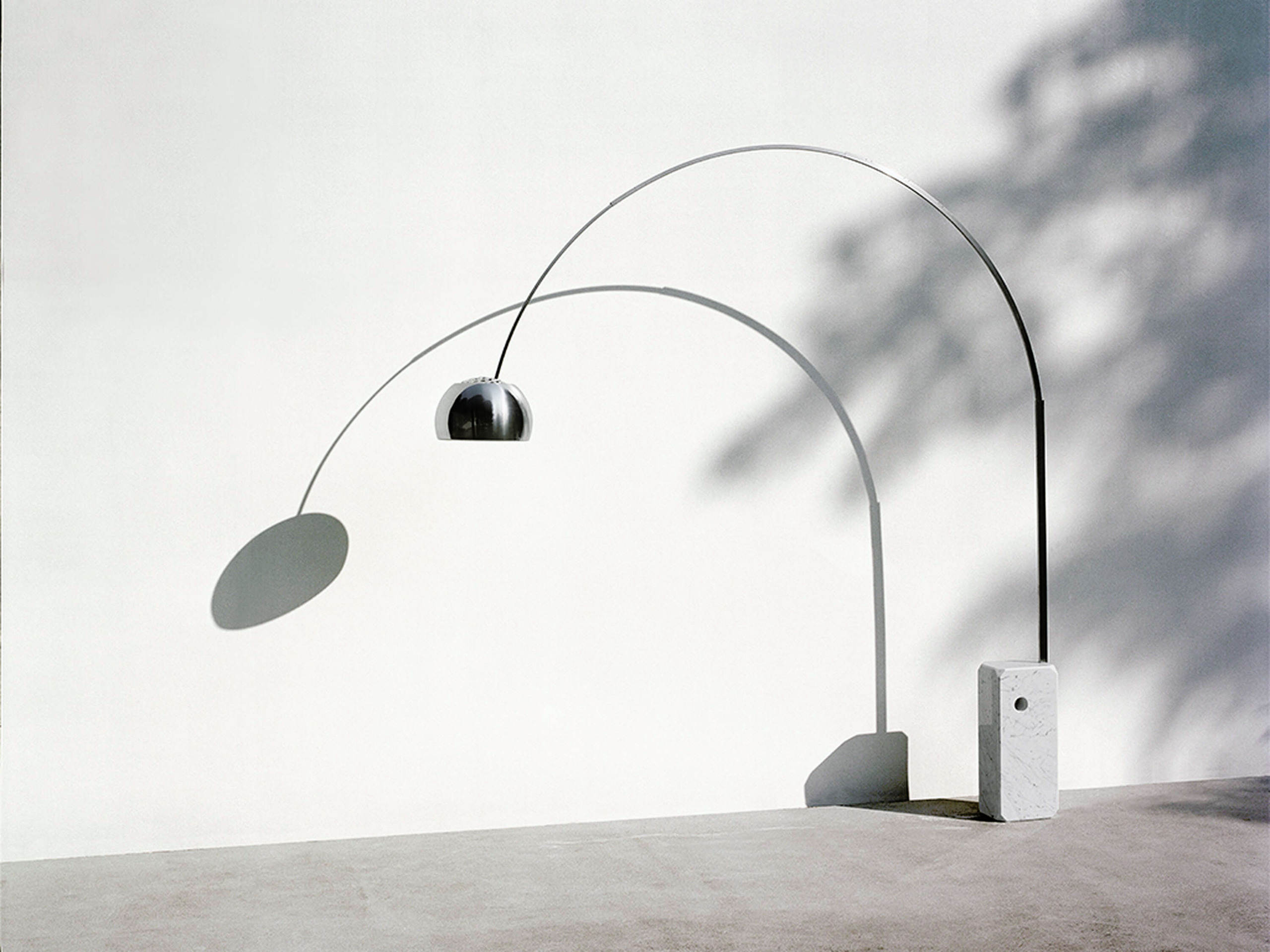
Arco became a floor lamp with an arc more than two metres long. The arc places the light source above a dining table, sofa arrangement or meeting area without a single ceiling fixing. The successful construction has remained almost unchanged for six decades.
Arco engineering still attracts attention. A solid block of Carrara marble weighing about 65 kilograms forms the base. The base supports the long metal arc and allows the lamp to be moved safely. A hole through the base accommodates a wooden bar, allowing two people to move the construction without dismantling it.
Arco is now considered one of the most copied objects in the history of industrial design. European market experts estimate that hundreds of manufacturers have produced replicas and imitations. The original Flos model remains the reference for quality and proportion. In 2020, the Supreme Court of Italy again confirmed strong legal protection for the model as a work of industrial art, a rare outcome for an object created more than sixty years ago.
Few design objects retain commercial relevance across generations. Arco has retained that relevance.
Taccia, the lamp that anticipated technology by decades
Taccia shows how a great idea can sometimes wait for the right technology.
The first sketches appeared in 1958, four years before Flos was founded. Achille Castiglioni wanted to use a transparent plastic reflector, but late-1950s technology could not support the design. Incandescent bulbs generated too much heat, causing the material to deform quickly.
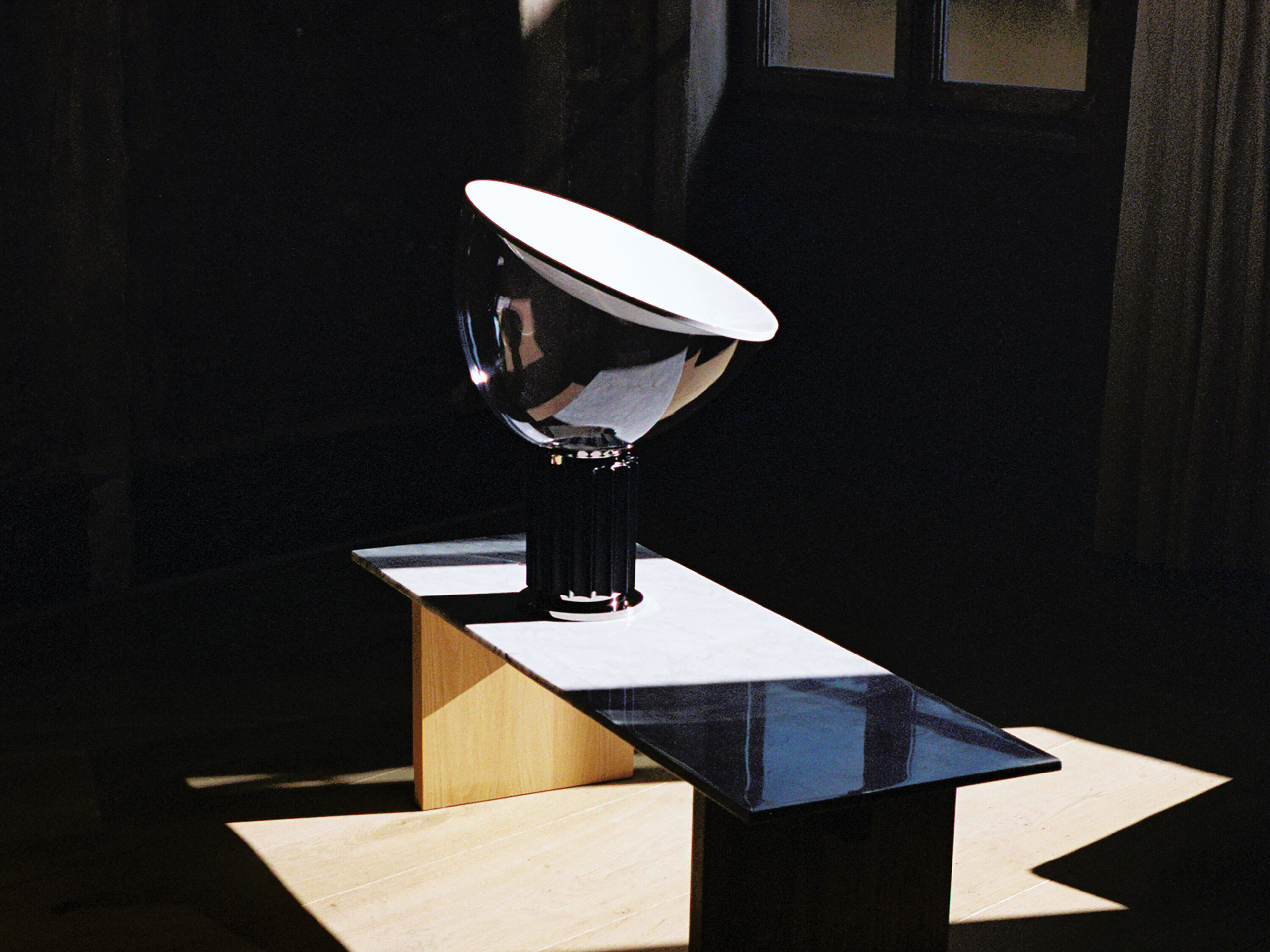
The solution was unexpected. The designer replaced plastic with a solid glass diffuser mounted on an aluminium base with deep cooling ribs. The ribs were not decorative. The ribs formed a radiator that efficiently removed heat from the light source.
Decades later, LED technology virtually eliminated the heating problem. Flos could return to Castiglioni's original idea and release a modern Taccia version with a polycarbonate reflector.
Castiglioni once called Taccia the “Mercedes among lamps”. The comparison proved remarkably accurate. Taccia was never built around fashion, just as the legendary German cars were not built around fashion. Engineering precision has always remained the model's main strength.
Taccia is now one of the best-known table lamps of the twentieth century. The model remains part of exhibitions at leading industrial design museums.
Parentesi, the object that proved a lamp needs neither walls nor a ceiling
Interior design moved rapidly away from static solutions in the mid-1970s. Spaces became more open, while furniture became more mobile. Lighting remained firmly tied to the architecture of the room.
In 1971, designer Pio Manzù proposed a radical idea: mount a lamp on a tensioned steel cable instead of attaching the lamp to a wall or ceiling. Achille Castiglioni completed the project after Manzù's tragic death. Flos introduced Parentesi in 1971 and 1972 as one of the brand's most unusual lamps.
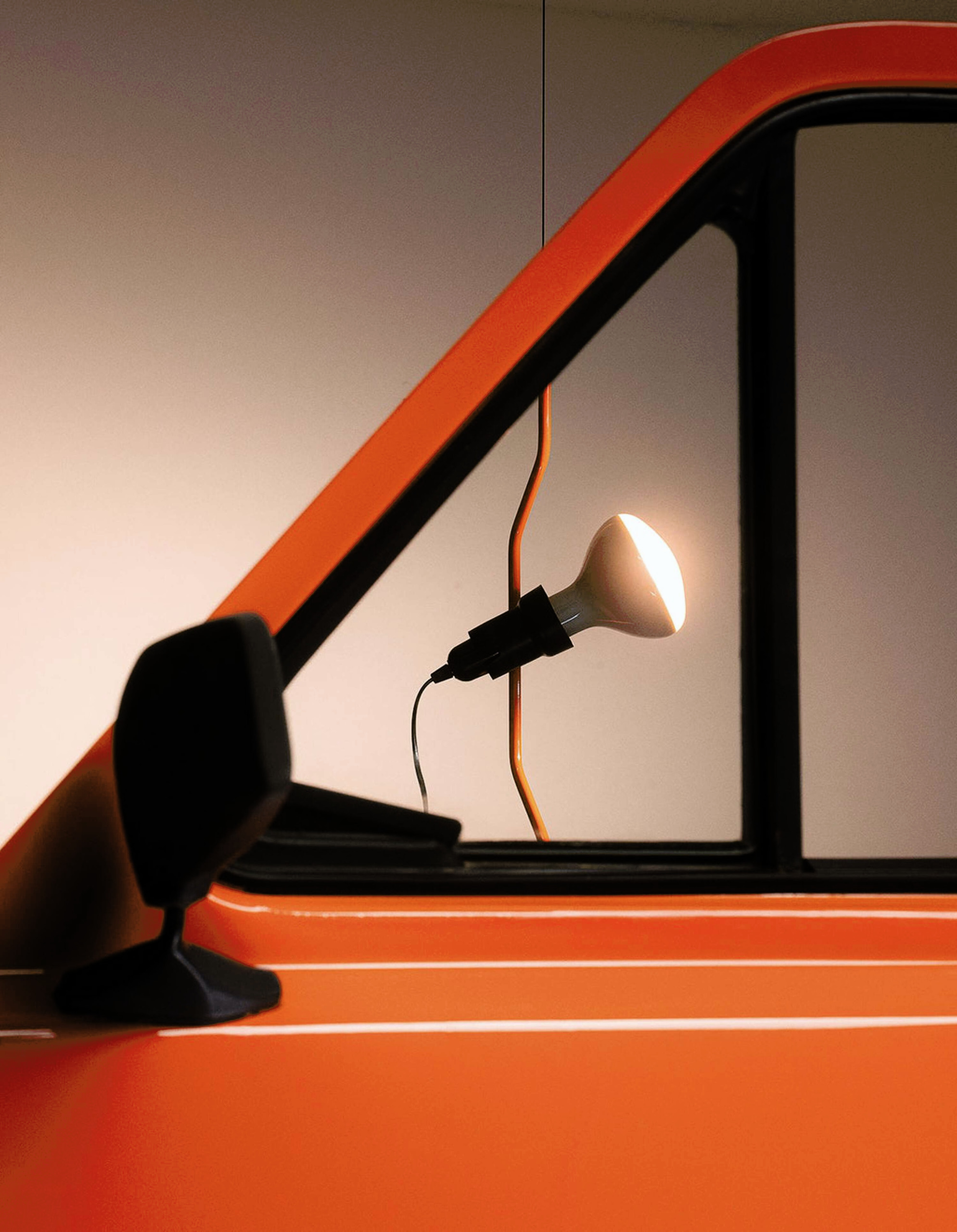
The construction is so simple that the solution seems obvious. A vertical cable is fixed between the floor and ceiling, while the light source moves freely up and down with one hand movement. The simplicity changed the role of lighting. Light stopped being a static interior element and gained genuine freedom of movement.
More than half a century later, Parentesi remains in production with almost no changes. The model is one of the most recognisable objects of Italian radical design. Parentesi received the prestigious Compasso d'Oro award in 1979, Italy's highest industrial design award. Many manufacturers began experimenting with mobile lighting systems after Parentesi, but few matched its concise form and direct engineering.
IC Lights, the lamp that appears to defy the laws of physics
Flos introduced a collection in 2014 that became one of the most discussed launches among design professionals within several months. Michael Anastassiades said the idea came from watching a street juggler balance a ball on the tip of a thin pole. The designer realised that balance could become the main decorative device.
IC Lights emerged from that idea.
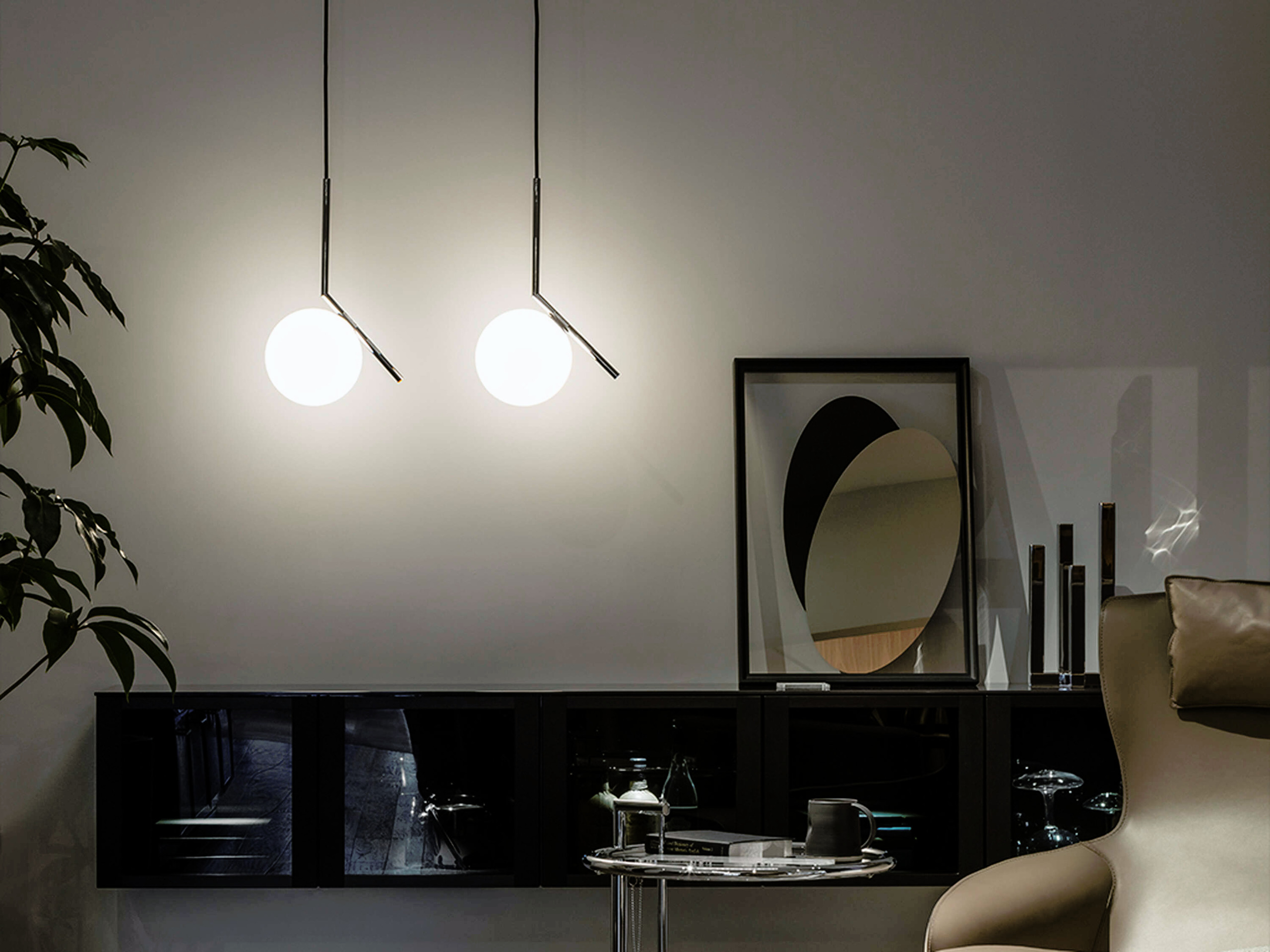
A glass sphere appears to have stopped by chance on a metal profile, balancing on the edge. A light touch seems capable of making the composition lose its stability. The illusion gives the lamp its distinctive engineering character.
Flos engineers had to solve several problems to create IC Lights. The glass shade's point of support was calculated with great precision. The centre of gravity was shifted to provide complete stability without bulky fixings. Visual lightness comes from complex engineering calculations that remain invisible to the viewer.
In less than ten years, the collection became one of the best-selling collections in modern Flos history. IC Lights is now produced in table, floor, pendant and wall versions. The recognisable silhouette has become a new classic of minimalism. Specialists already place this twenty-first-century object alongside Arco and Taccia.
Snoopy, the irony that became timeless
Industrial design includes few objects that can make people smile while also impressing engineers. Snoopy, created by the Castiglioni brothers in 1967, is one of those objects.
The name came from an association with the silhouette of the famous comic character created by Charles Schulz. The simple exterior conceals a carefully engineered construction.
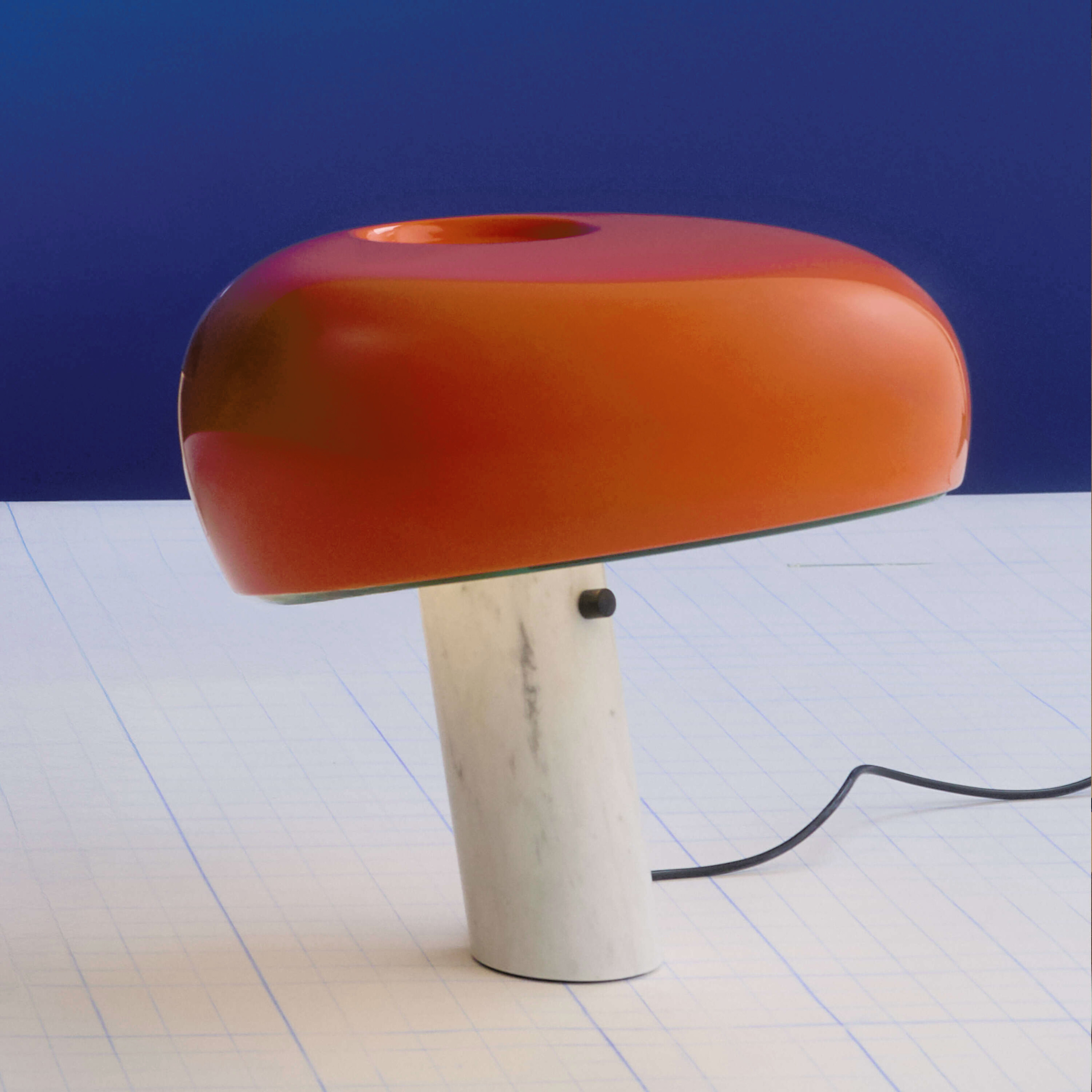
A heavy white marble base provides complete stability. A metal reflector has an enamel coating that preserves colour depth after decades of use. The shade's inner surface directs light efficiently onto the work surface without dazzling the user.
Snoopy was one of the first design lamps to prove that emotional appeal can coexist with function. Industrial design before Snoopy aimed to look strictly rational. The Castiglioni brothers showed that an object could have character and humour while remaining technically precise.
Snoopy is now one of the world's best-known table lamps. The model remains in production almost sixty years after its launch, a fact that demonstrates the model's status.
Why Flos remains a reference for the lighting industry
Flos history cannot be explained only by famous designers or effective marketing. The brand's main achievement is the ability to create objects that do not become outdated with interior fashion.
Almost all of the company's iconic models appeared more than half a century ago. The market has since moved from incandescent bulbs to LED technology, developed smart home systems, adopted wireless control and passed through dozens of interior trends. Arco, Taccia, Parentesi and Snoopy continue in production with almost no changes. Specialists already call IC Lights the leading candidate for new classic status in the twenty-first century.
Antonovych Home director Dmytro Korotchuk says that long-term relevance has become the main selection criterion for premium-segment clients.
“People's relationship with interiors has changed in recent years. People buy objects for five years less often. People look for pieces that will remain relevant in twenty years and retain their value after the next exhibition in Milan. Flos is one of the few brands that has passed this test of time. Flos iconic lamps do not follow trends. Flos iconic lamps become reference points for new generations of designers.”
Flos therefore remains more than a decorative lighting manufacturer. The brand continues to shape the professional language of contemporary architecture, where light has moved beyond a technical function to become a material for design.
Decades pass, technologies change and new names appear, but one rule remains unchanged.
Not every lamp becomes history. These five did.