
TILE by Baxter: When Tile Becomes Spatial Design
What happens when a familiar geometric module loses its familiar function? Baxter already has the answer: TILE, a limited-edition capsule collection created by the creative duo Draga&Aurel. The collection turns “tile” from a finishing material into a design tool that is soft, dimensional and capable of forming an almost limitless number of configurations.
The collection was presented at Baxter Cinema in Milan during Milan Design Week 2026. The collection will join the Baxter Gallery London programme in September as part of London Design Festival. TILE interests the professional design community primarily as an example of how the meaning of modularity is changing in contemporary interiors.
1. When Tile Becomes a System
The name TILE deliberately refers to one of the most recognisable elements in design, the tile. Draga&Aurel propose viewing the tile in a completely different way.
The collection is based on the concept of the “soft tile”, a geometric module that can be combined, repeated, connected and transformed. A flat surface gives way to volume, while a fixed pattern becomes a system that can change according to the project brief.
TILE marks an important shift for designers. The collection does not simply offer a finished decorative pattern; the collection provides a tool for creating an individual pattern.
Modularity in TILE does not follow the principle of one element serving one function. Separate parts can form volumes and new spatial configurations, with each composition adapted to a specific interior.
TILE is therefore better understood as a kind of construction system than as a collection of separate objects.
2. The “Soft Tile”: Why the Concept Goes Beyond a Striking Image
The idea initially appears paradoxical. Tile is associated with hardness, surface and repetition, while Baxter turns tile into a soft, three-dimensional element.
The contrast is the collection’s central design device.
Draga&Aurel work with geometry so that geometry no longer remains static. The module can create relief, volume, rhythm and tactility. The familiar grid consequently becomes a spatial tool.
The system gives interior designers several possible applications, including an accent wall, a decorative composition or an independent three-dimensional object.
The result depends not only on the module itself but also on the way the module is assembled. Two interiors based on the same TILE system can therefore look completely different.

3. Draga&Aurel: Between Art and Product Design
The creative duo Draga&Aurel has long worked at the intersection of art, design and material experimentation. The duo’s approach is difficult to reduce to conventional industrial design. An object often becomes part of a broader visual and spatial narrative.
TILE expresses this philosophy with particular clarity.
The collection recalls an architectural module, a sculptural object and a piece of furniture at the same time. The collection does not prescribe one method of use; the collection leaves room for a designer’s interpretation.
TILE is therefore especially relevant to professionals. The project does not simply seek to create another decorative element. The designers examine how far the familiar idea of a module can be expanded.

4. Baxter and a New View of Modularity
Modularity has long been one of the key tools in contemporary interior design. The ability to combine elements, however, is no longer enough by itself.
A professional interior requires systems that can adapt to a space, change scale, create different scenarios and retain a recognisable visual language.
TILE responds to this requirement.
Modularity becomes part of the aesthetics rather than a technical specification. Repeated elements create rhythm, changes in position create movement, and combinations of several modules produce new volumes.
The approach is particularly relevant to large private interiors, hospitality spaces, lounge areas and representative premises. Designers can treat a surface as an active part of the composition rather than as a background.

5. TILE at Baxter Cinema: The Collection as an Exhibition Object
The choice of venue for the first TILE presentation is also significant.
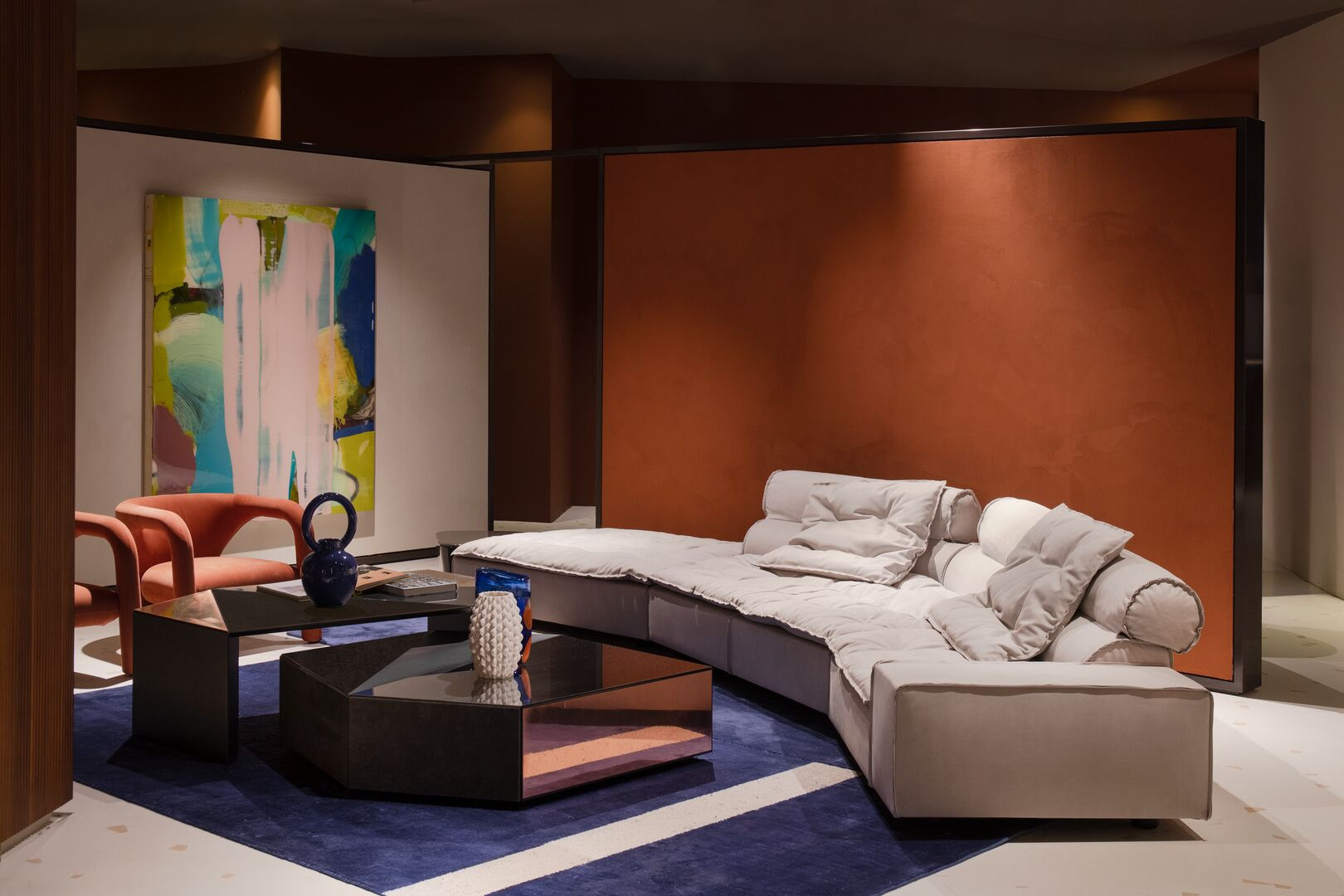
The collection was presented at Baxter Cinema in Milan during Milan Design Week 2026. In this setting, TILE is perceived not simply as a product but as a spatial installation that demonstrates the system’s possibilities.
The presentation reflects Baxter’s characteristic strategy of showing design within an environment where the design’s sculptural and tactile qualities can be experienced as part of a complete setting.
The next venue is Baxter Gallery London, where the collection will be presented from September as part of London Design Festival.
Presentations of this kind are important to designers because presentations reveal not only an individual object but also the logic of its interaction with space.

6. The Baxter Collection at Antonovych Home
Antonovych Home presents Baxter in its showroom, creating a selection of Italian design for professional interior projects.
TILE should also be viewed within Baxter’s broader aesthetic. Baxter is a brand defined by expressive form, tactile materials, craftsmanship and an emotional response to objects.
Designers working on high-level projects value this approach because the approach selects objects by building an individual spatial character rather than by following formal stylistic compatibility.
TILE reflects the direction in which contemporary Baxter is developing. An object gradually moves beyond its original function and becomes a tool for creating atmosphere and a spatial scenario.

7. Expert View from Dmitry Korotchuk
Dmitry Korotchuk, director of Antonovych Home:
“TILE is particularly interesting because Draga&Aurel offer designers a system rather than a completed decorative image. The distinction is fundamental. A professional can change the configuration of an element and gain much greater freedom when working with a specific space.
The reinterpretation of tile is especially important to me. We are accustomed to viewing tile as a surface, a wall, a floor or a background. TILE makes tile work in three dimensions, turning tile into volume and an independent visual accent. Contemporary interiors increasingly value individuality and authorial interpretation, so the approach has strong potential.”
The expert believes that the value of collections such as TILE lies in the ability to give designers an additional tool without limiting designers to one predetermined scenario.

8. Why Professionals Should Consider TILE
TILE is a clear example of how product design is developing today. The boundaries between furniture, objects, finishes and art are becoming less distinct.
The shift gives designers more freedom and also creates more responsibility. Expressive modular systems require a considered composition.
The final result with TILE depends largely on how a designer uses the module. The module can become an almost invisible part of a surface, or the module can become a dominant three-dimensional interior element.
This variation keeps the collection relevant beyond a single season. The underlying idea of a modular system remains adaptable, unlike a decorative technique tied to a specific aesthetic.
Key takeaway
TILE by Baxter and Draga&Aurel is more than a new interpretation of tile. The collection attempts to turn a familiar geometric element into a complete tool for spatial design.
The limited-edition status strengthens the collection’s position, but exclusivity is not the central point. The more important principle is that one module can become many different solutions.
Products of this kind are particularly valuable to professional designers because products do not dictate an interior; products give designers the opportunity to create one.
