
Yuan: Where East Meets Italy
Yuan, created by the Chinese studio Outin.Design for Giorgetti, begins with a ritual rather than a decorative image. The collection draws on the Chinese tea ceremony, ideas of origin and memory, natural materials and Italian craftsmanship. Outin.Design founder Chen Wang treats design as a way to translate cultural experience into a material language, preserve a ritual, renew a traditional technique and create an object where different cultural codes exist without literal quotation. Yuan brings Eastern philosophy together with Italian expertise, while tea leaves become part of the new Antichi Impasti Romani® material.
1. East without decorative quotations
Yuan avoids obvious ornaments, traditional symbols and literal Chinese forms. The collection expresses Chinese culture through ritual rather than visual imitation.
Chen Wang and the Outin.Design team focus on the Chinese tea ceremony as a sequence of actions, gestures, distance between participants, attention to guests, pauses and an awareness of time.
Yuan creates a contemporary spatial setting for the tea ceremony rather than simply describing the ceremony.
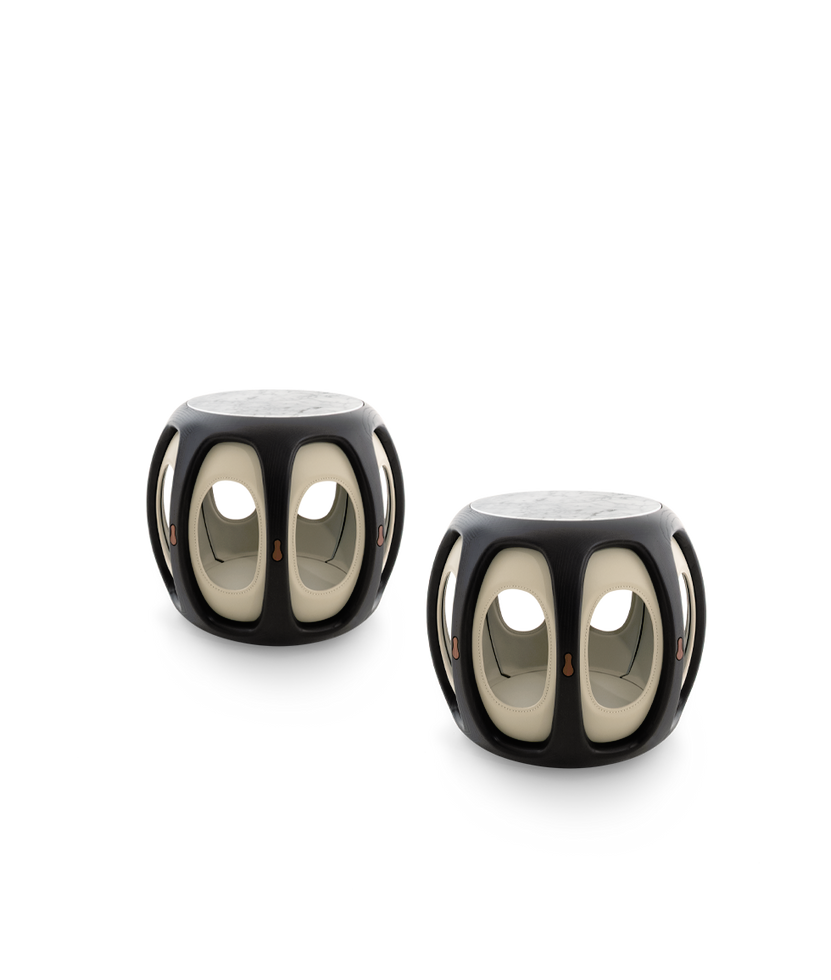
Giorgetti describes the collection as a dialogue between solids and voids, where an ancient ritual continues in a contemporary form. The Tea Collection includes a table, armchair, pouf and low table.
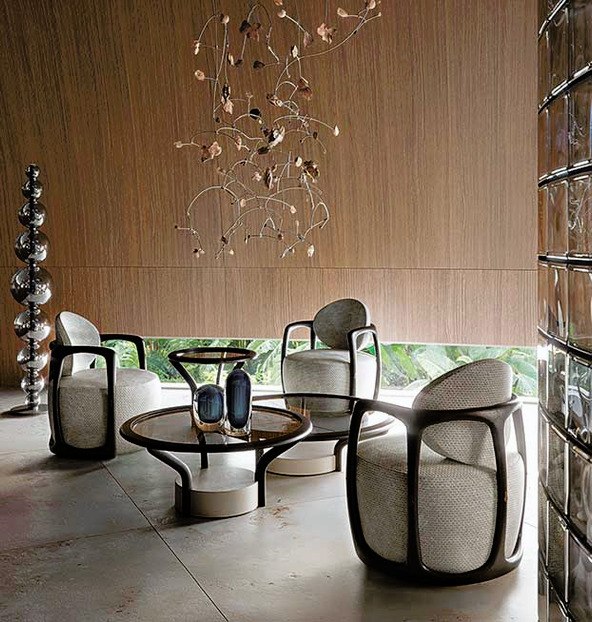
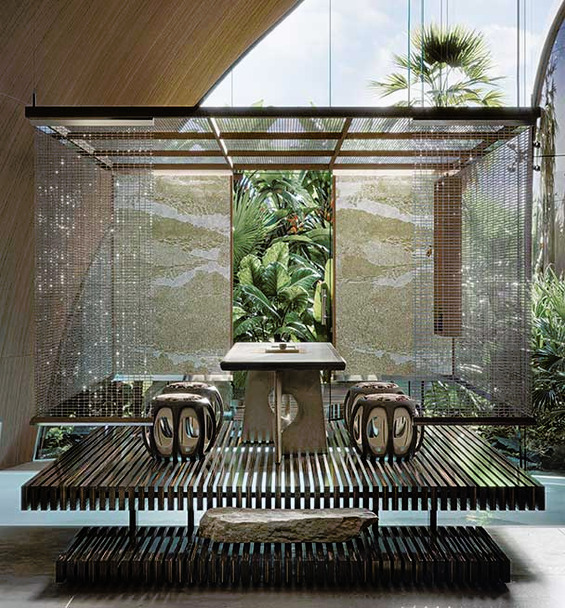
The collection supports two distinct settings: an intimate tea ritual and a more familiar dining conversation.
For interior designers, Yuan demonstrates that a cultural code can appear in human behaviour rather than decoration. The approach allows the furniture to enter a contemporary interior without becoming a stylistic imitation.

2. A table that organises conversation
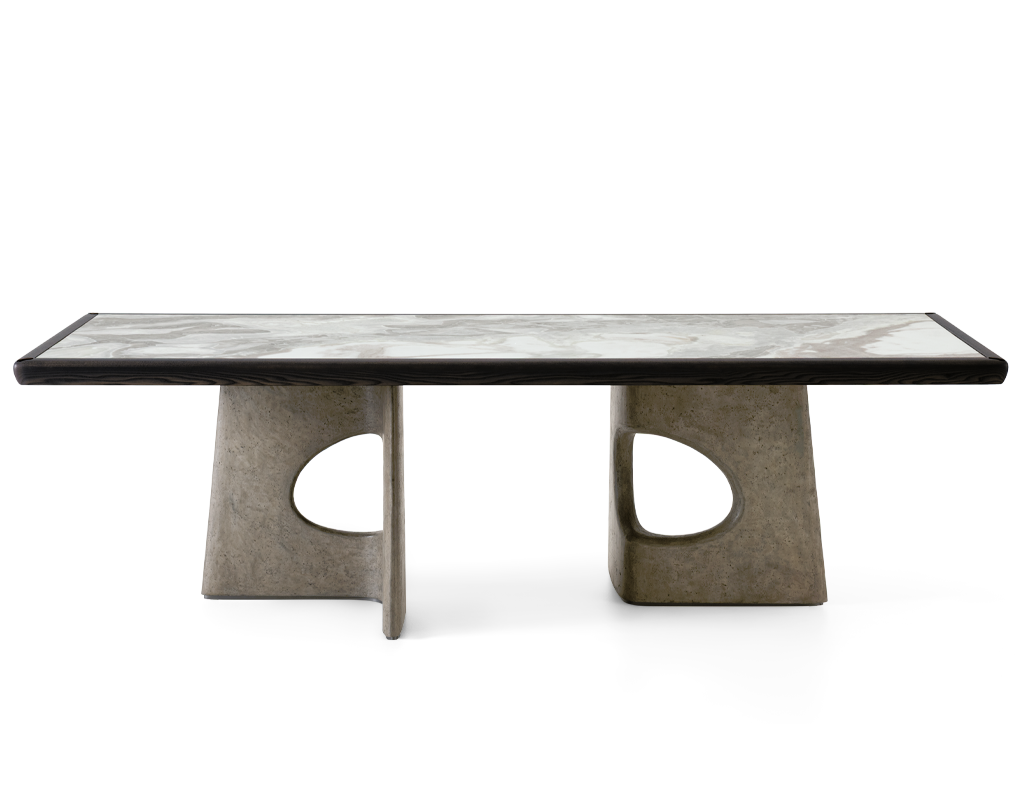
The Yuan table organises conversation through solid supports, internal voids and proportions designed for different settings. The tea table measures 69 cm high and 230 × 83 cm. Dining versions measure 74 cm high and come in rectangular sizes of 250 × 110 and 300 × 110 cm, plus round diameters of 180 and 240 cm.
The main Yuan piece is the table. L-shaped bases create a graphic structure that makes the table sculptural while keeping its appearance visually light.
The void is as significant as the material. The tea version measures 69 cm high and 230 × 83 cm. Dining versions measure 74 cm high and come in rectangular formats of 250 × 110 and 300 × 110 cm, plus round diameters of 180 and 240 cm.
The different sizes reflect two types of interaction rather than simple variations of one table.
The tea version supports a more intimate setting. The dining version accommodates a more open arrangement for a larger group.
The visual language remains consistent through wood, marble, leather and Antichi Impasti Romani®. Giorgetti highlights the material dialogue between warm ash, cool marble, mineral depth and soft leather. The table can act as a compositional centre in an interior project without relying on overt decoration.

3. Yuan's most unexpected feature is inside the material
Yuan's central material experiment appears on the surface. Antichi Impasti Romani® is a new Giorgetti material based on ancient Roman techniques.
The material contains aged lime paste, siliceous sands, marble powders, pozzolans and natural pigments. Specialists apply the material by hand in layers, using techniques inspired by fresco painting. Yuan adds another element to the composition.
Tea leaves are incorporated into the material.
The tea ceremony therefore connects with the furniture through the material itself. Traces of the ritual become part of the surface. Chinese tradition does not become a decorative motif, and Italian technique does not function as a simple finish.
Both traditions meet inside the surface. Giorgetti states that tea leaves give the material organic nuances and a subtle aromatic note. The surface becomes visual, tactile and olfactory. Yuan expands the usual discussion of materials through a multisensory interior approach.
Colour and form remain important, while texture, surface temperature, sound, light and scent add further dimensions. Antichi Impasti Romani® follows that approach. Hand application gives every surface individual nuances. The material can absorb and reflect light, create depth and produce variations in colour and texture. The finish becomes part of the object's story rather than a background.

4. When two traditions meet through craftsmanship
Yuan brings Italian and Chinese contributions together through craftsmanship rather than dividing them into idea and production. Antichi Impasti Romani® is applied entirely by hand by specialist restorers at a Florentine art workshop that has operated since 1956.
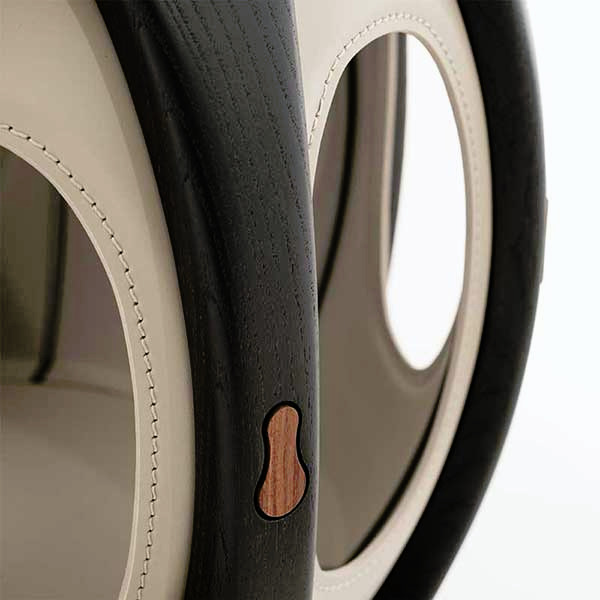
The historical technique becomes part of contemporary industrial design. Giorgetti does not simply produce furniture from a Chinese designer's sketch. Yuan joins Chinese ritual culture with the Italian preservation of craft knowledge. Pau Ferro appears in the construction, while small inserts take the form of an eight.
Chinese culture traditionally associates the number eight with prosperity. The symbolism remains discreet and does not need to be read literally for the furniture to function as contemporary design.
For professional designers, Yuan shows how cultural identity can be built into construction, material and use rather than direct national references.

5. Chen Wang: design as a way to preserve ritual
Outin.Design founder Chen Wang describes Yuan as a project where materials, craftsmanship and nature form a new design language.
Giorgetti presents Chen Wang in the Giorgetti Voices series as a designer exploring the relationship between Chinese tea culture, heritage and contemporary furniture.
The name Yuan has an additional meaning in this context. Giorgetti connects Yuan with a Chinese character referring to origin, beginning and source. The project returns to the source not to repeat the past literally, but to understand what can enter contemporary life.
Yuan does not look historical. The collection has contemporary construction, proportions and material language. The collection also supports an ancient human scenario: people gather, pause, prepare tea and talk.
The story gives an interior a stronger cultural basis than visual styling. Yuan can remind people of ritual without requiring specialist knowledge of the cultural context.

6. Dmitry Korotchuk's view: an object should have its own story
For Dmitry Korotchuk, head of Antonovych Home, Yuan is valuable because the collection connects a clear concept with practical furniture value.
“Yuan cannot be reduced to one characteristic. The collection combines expressive construction, complex material work and specific cultural content. The collection does not look ethnographic. Contemporary interiors benefit from furniture that has history and character without imposing a particular style on the space.”
The expert believes designers increasingly select objects that shape daily scenarios rather than isolated visual statements. “Antichi Impasti Romani® is especially significant. The material becomes part of the narrative. Tea leaves within the mineral mass connect the surface with the collection's original idea. The manufacturing technology becomes part of the object's artistic content,” says Dmitry Korotchuk.
Antonovych Home evaluates furniture through materials, proportions, execution quality and performance within a specific project, alongside photography and brand recognition. Giorgetti is represented at Antonovych Home in Astana.
Giorgetti is one of the European factories represented in the showroom catalogue. The Antonovych Home website has a dedicated Giorgetti brand page and product catalogue. Antonovych Home occupies more than 1000 m² of exhibition space in Astana, with furniture, kitchens, dressing rooms, lighting and materials. The company also provides project furnishing, logistics and installation.
For designers, direct contact with the furniture helps reveal the scale, surface and detail quality of complex pieces such as Yuan.
7. Why Yuan matters in contemporary interiors
Yuan shows how contemporary furniture can retain tradition without copying it, reveal material origins and support a specific way of living. The collection includes a table, armchair, pouf and low table. Together, the pieces create a setting for conversation, pauses and ritual rather than functioning only as a furniture group.
Yuan suits more than dining rooms. The tea table can centre a private living-room zone, intimate lounge area or conversation space. The armchair can stand alone or join other pieces.
The pouf and low table continue the same material and sculptural language in other interior zones. Yuan does not require numerous Eastern details. The collection already contains substantial cultural meaning. The furniture suits a calm setting with natural wood, stone, soft textiles, subdued lighting and space between objects.
The result is neither a decorative image of China nor a display of Italian craftsmanship. Yuan creates a dialogue between two cultures through material and human gesture.
Instead of an epilogue: an object that remembers
Strong furniture design does not always seek attention. Yuan can hold the gaze, invite touch and change a familiar pattern of conversation. The Chinese tea ceremony provides the starting point.
Italian craft technique becomes the instrument. Tea leaves become material evidence of cultural dialogue. Wood, marble and leather connect the collection with contemporary interiors. The person who sits at the table, lifts a cup, talks and pauses remains central.
Yuan feels relevant not only as a 2026 novelty, but as an object designed for a much longer life.
The story begins with tradition but does not end there. Yuan does not simply describe the past. The collection brings the past into the present.